
The Electrification of Capital: Analyzing the EV and Technology Ecosystem
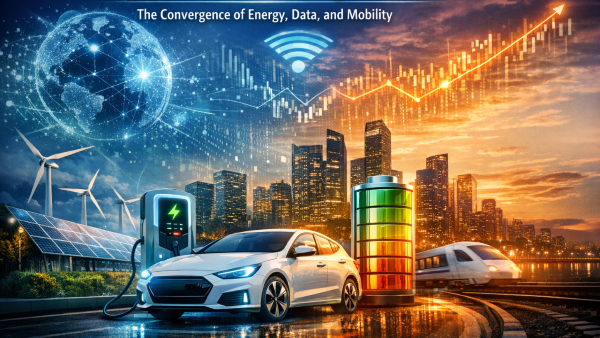
PART I: The Convergence of Energy, Data, and Mobility
Author: Arshad Shamsi
Date: January 2026
Introduction: The Transition to Software-Defined Mobility
When we examine the history of industrial economics, the transition from Internal Combustion Engines (ICE) to Electric Vehicles (EVs) is not simply a shift in how people move from point A to point B. It represents a Disruptive Innovation (Christensen, 1997) that is fundamentally rewriting the structure of transportation.
At its core, this shift is more than mechanical progress; it marks a systemic transformation. In simple terms, an EV functions as a Software-Defined Vehicle (SDV)—a mobile computing platform where artificial intelligence, advanced semiconductors, and high-density energy storage converge.
For students and professionals in finance and consulting, one insight stands out clearly: the automotive sector has moved away from the slow, linear cycles of traditional manufacturing and entered the high-velocity innovation environment typical of the technology industry.
Author’s Note: In more than two decades of my experience in managing complex operational systems in healthcare and pharmacy environments besides the Business Consulting, I have repeatedly observed a familiar pattern. Every time an industry transitions from a hardware-first model to a software-first architecture, legacy assumptions around value, depreciation, and operations no longer apply. In exactly the same way that digital systems transformed patient care and pharmacy billing in the last 20 years. In exactly the same fashion, the electrification of capital is redefining vehicles from purely mechanical assets into dynamic, software-driven systems embedded within global financial and energy networks.
Methodology Note: This article synthesizes academic research, public policy frameworks, and observed industry trends to examine the financial and technological evolution of electric mobility.
Stoctok Educational Policy: This article is intended strictly for educational and market-literacy purposes. It does not provide financial advice, investment recommendations, or commercial guidance.
1. The EV as a Digital Asset: Changing Consumer Behavior
Over recent years, the adoption of EVs has driven a noticeable shift in consumer psychology. Viewed through the lens of Utility Theory, this transition reflects changing perceptions of value, ownership, and long-term utility.
-
From Refueling to Energy Management: Global studies indicate that consumers are gradually moving away from a traditional “service station” model toward an integrated energy model, where charging, storage, and consumption are coordinated within a broader ecosystem.
-
The “Prosumer” Shift: EV ownership—combined with digital charging networks and home energy systems such as solar and battery storage—turns consumers into “prosumers,” simultaneously consuming and producing energy.
-
The Software-as-a-Service (SaaS) Model: Automakers increasingly rely on Over-the-Air (OTA) updates, enabling vehicles to gain new features or performance improvements after purchase. This mirrors the smartphone ecosystem, where software updates preserve relevance and extend product life.
-
Predictive Maintenance: These Embedded AI systems continuously monitor battery health and mechanical stress in real time. This supports consumer expectations from reactive repair toward predictive uptime, redefining reliability standards in personal transportation.
2. The Battery Economy: Commodity and Geopolitical Markets
One of the most significant financial implications of the EV ecosystem lies in the battery itself, which typically accounts for 30% to 40% of total vehicle cost. This single component has reshaped global supply chains and commodity markets.
-
Wright’s Law and Experience Curves: As cumulative battery production increases, unit costs tend to decline at a predictable rate. This dynamic creates structural advantages for early participants that achieve scale, forming durable competitive barriers.
-
Commodity Volatility: Rising demand for lithium, cobalt, nickel, and copper has positioned the EV sector as a major driver of global metals and mining indices, effectively creating a new strategic market segment.
-
Vertical Integration: To reduce exposure to supply-chain disruption, manufacturers increasingly pursue “mine-to-motor” strategies, acquiring or partnering across raw-material production to stabilize long-term cost structures.
3. Infrastructure as a Strategic Monopoly
Charging networks are emerging as a new category of Energy-as-a-Service (EaaS) infrastructure—hard assets of the 21st century. In major metropolitan regions, these networks are already treated as essential components of urban mobility and energy resilience.
From a financial perspective, such infrastructure benefits from scale, network effects, and predictable utilization once adoption reaches maturity. Public policy plays a critical role in accelerating this transition. In the United States, programs such as the National Electric Vehicle Infrastructure (NEVI) initiative support nationwide deployment, while the European Union’s Alternative Fuels Infrastructure Regulation (AFIR) establishes a coordinated framework across member states.
-
Network Effects: The value of a charging network increases as EV adoption expands. The U.S. Inflation Reduction Act of 2022, through its Clean Vehicle Credit of up to $7,500 for qualifying new vehicles, has materially influenced consumer behavior. Comparable incentives across Europe and the United Kingdom—ranging from tax benefits to regulatory advantages—reinforce similar adoption dynamics.
4. V2G (Vehicle-to-Grid): Transitioning from Transport to Infrastructure
Looking ahead, the evolution of EV infrastructure increasingly centers on Vehicle-to-Grid (V2G) technology. This bidirectional energy model redefines the economic role of an electric vehicle.
Under V2G systems, an EV functions as a mobile battery asset rather than a passive transport device. Given that most vehicles remain parked for the majority of the day, V2G enables power grids to temporarily draw stored energy during peak demand periods. This capability supports grid stability, mitigates blackout risk, and moderates electricity price volatility.
As adoption scales, millions of EVs collectively form a distributed energy buffer. This transformation positions electric mobility not only as a transportation solution but also as a decentralized component of national energy infrastructure, reinforcing broader objectives around resilience and energy security.
Conclusion: Capital in Motion
The electrification of mobility reflects a deeper transformation in how capital, technology, and infrastructure intersect. EVs are no longer isolated consumer products; they are integrated digital systems embedded within financial markets, commodity flows, and energy networks.
For students and professionals in finance, understanding this convergence is essential. The EV ecosystem illustrates how value increasingly migrates toward software, data, and infrastructure coordination—reshaping both consumer behavior and global capital allocation in the process.
References & Further Reading
-
Christensen, C. (1997). The Innovator’s Dilemma. Harvard Business School Press.
-
International Energy Agency (IEA). Global EV Outlook.
-
U.S. Department of Energy. National Electric Vehicle Infrastructure (NEVI) Program.
-
European Commission. Alternative Fuels Infrastructure Regulation (AFIR).
Stoctok Educational FAQ
Q1: Why are EVs considered “Computers on Wheels”? Unlike traditional cars, EV vehicles value is derived from software-controlled systems, these technology driven computers manage everything from battery efficiency to self-driving capabilities.
Q2: What is ‘Vertical Integration’ in the EV world? It is the strategy where a company controls multiple stages of the supply chain—from mining the lithium to building the battery and designing the car software—to reduce costs and supply risks.
Q3: How do EVs affect the global energy grid? They act as a “Massive Distributed Battery.” If managed correctly, they can store excess renewable energy (like solar or wind) and release it when the grid needs it most.
Your post is not just great; it\’s outstanding! It\’s evident that you put a lot of effort into creating this, and it shows. I look forward to your future posts.\”
Thank you for taking the time to share your thoughts. Your positive feedback is a reminder of why I love what I do.
I\’m so glad I stumbled upon this post. It\’s a breath of fresh air in the crowded world of WordPress content. Keep up the excellent work!
Thank you so much for your kind words! I\’m thrilled to hear that you enjoyed