
Why Understanding Stocks Matters
Stocks have been one of the most powerful wealth-building tools since the birth of financial markets. Whether you’re a beginner investor, a family saving for the future or a business seeking growth, stocks provide.
- Capital growth
- Passive income through dividends
- Long-term financial security
Yet, for many people, the stock market feels complex and intimidating. This guide breaks it down into simple terms covering what stocks are, their types, how to value them and how to pick the right ones for your portfolio.
What Is a Stock?
A stock represents ownership in a company. When you buy stock, you become a shareholder, gaining rights such as.
- A share of company profits (dividends, if paid).
- Voting rights (for common stockholders).
- A claim on company assets in case of liquidation.
Why do companies issue stocks?
- Expansion into new markets.
- Infrastructure upgrades (technology, equipment).
- Research, innovation or debt repayment.
For investors, stocks provide a way to grow wealth without managing a business directly.
Types of Stocks
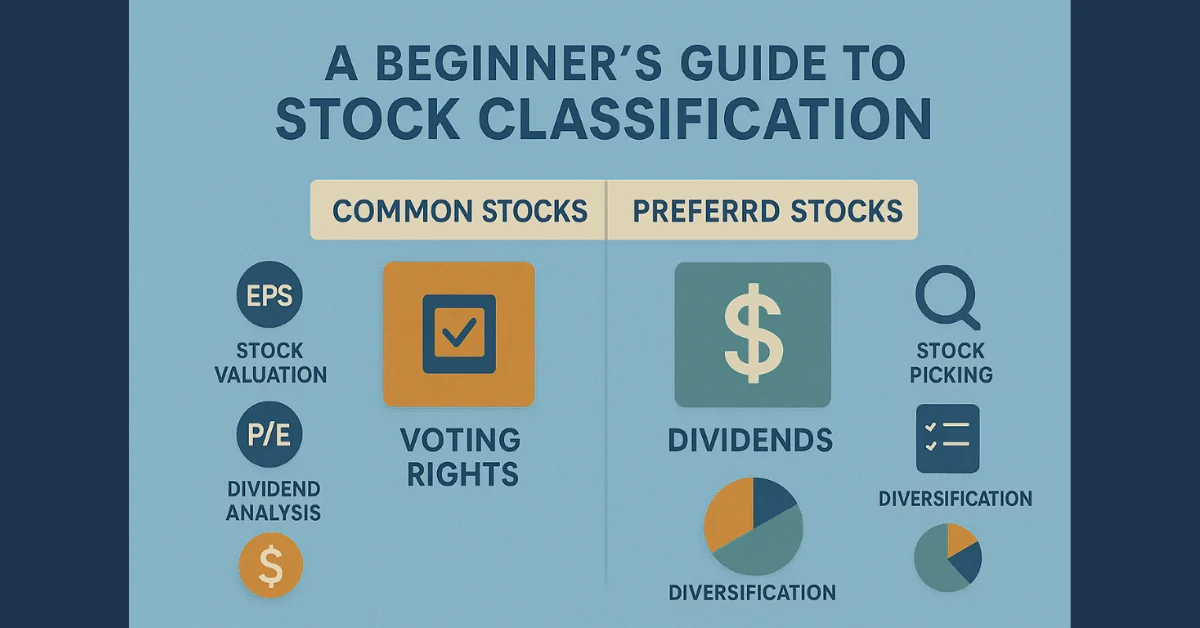
1. Common Stocks
- Most widely traded.
- May pay dividends, depending on company policy.
- Provide voting rights in shareholder meetings.
- Offer higher returns, but carry more risk.
2. Preferred Stocks
- Priority in dividend payments.
- Higher claim on assets during bankruptcy.
- Usually no voting rights.
- Seen as a hybrid between stocks and bonds (steady income + ownership).
Stock Assessment: Why Do Companies Issue Stocks?
Companies issue stocks mainly to.
Raise Capital: for growth, expansion or modernization.
Invite Public Participation: allowing individuals to share in success.
Create Shared Wealth: enabling those who can’t run businesses to still earn returns.
This creates a win-win system, connecting business innovation with investor opportunity.
Stock Valuation: How Do We Know a Stock’s Worth?
Valuation is key to smart investing. It helps you decide if a stock is fairly priced, undervalued or overvalued.
1. Earnings Per Share (EPS)
Formula: Net Income ÷ Outstanding Shares
- Shows how much profit each share generates.
2. Growth Rate
- Historical growth in sales and earnings.
- Consider industry outlook and management quality.
3. Price-to-Earnings (P/E) Ratio
Formula: Stock Price ÷ EPS
- Indicates how much investors are willing to pay for $1 of earnings.
- Useful for industry comparisons.
- Average U.S. market P/E ≈ 16 (Bloomberg data).
4. Dividend Analysis
- Measures cash flow returned to shareholders.
- Blue-chip companies like Johnson & Johnson and Procter & Gamble are known for steady dividends.
Try Stoctok’s Stock Profit & Loss Calculator to analyze potential returns.
Stock Picking: How to Choose the Right Stocks
1. Do Your Homework
- Read annual reports and financial statements.
- Track quarterly earnings calls.
2. Check the Fundamentals
- EPS growth trend.
- P/E ratio vs competitors.
- Dividend history.
3. Diversify Your Portfolio
- Spread investments across sectors.
- Mix growth stocks with defensive sectors.
4. Think Long-Term
- Avoid hype-driven investments (e.g., meme stocks).
- Focus on companies with sustainable advantages.
Making Stocks Easy for Everyone
Beginners: Start with index funds or ETFs for instant diversification.
Intermediate investors: Learn valuation basics to select individual stocks.
Advanced investors: Explore sector rotation, global equities and options.
Helpful Resources:
- Investopedia – Stock Basics
- Morningstar – Stock Analysis
FAQs: Stock Classification & Valuation
Q1: What is the simplest definition of a stock?
A stock represents ownership in a company, with rights to profits (dividends) and possibly voting rights.
Q2: What’s the difference between common and preferred stocks?
Common: voting rights + higher risk/reward.
Preferred: priority dividends + safer, but no voting rights.
Q3: How do I know if a stock is overvalued?
Check the P/E ratio, compare with industry averages and review growth trends.
Q4: Should beginners invest in individual stocks?
Start with ETFs or index funds for safety. Move to individual stocks later.
Q5: Why do companies issue stock?
To raise money for expansion, innovation or debt repayment while allowing the public to invest.
Conclusion:
Stocks are not just numbers on a trading screen they represent ownership, growth and financial opportunity. Every share you own connects you directly to a company’s success story, giving you a stake in its profits, innovations and long-term vision.
By understanding:
- Stock classification (common vs. preferred stocks)
- Valuation methods (EPS, P/E ratio, dividend analysis)
- Stock-picking strategies (research, diversification, long-term focus)
you gain the ability to make informed decisions that can build lasting wealth, protect against inflation and guide you toward financial independence.
The beauty of the stock market lies in its flexibility it welcomes everyone, from cautious beginners investing in ETFs to advanced investors exploring international markets. With patience, consistency and the discipline to ignore short-term noise, anyone can benefit from the market’s wealth-building potential.
In the long run, the stock market rewards those who focus on value, fundamentals and long-term growth. It’s not about timing the market, but about time in the market. By starting early, staying diversified and making educated choices, you set yourself on a path toward financial freedom and the ability to secure a better future for yourself and your family.
Remember: Investing doesn’t have to be intimidating. With the right knowledge and mindset, the stock market becomes not just a place to trade, but a powerful partner in achieving your financial goals.