
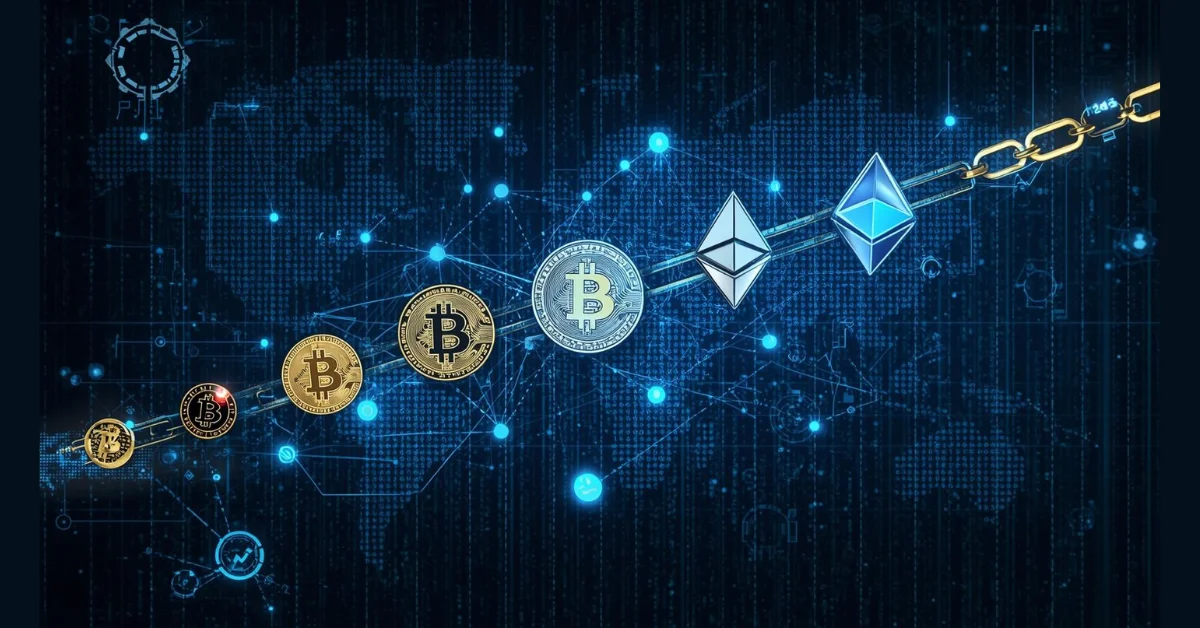

The Digital Odyssey: Foundations of Cyber Currency (2008–Present)
A Deep Dive into the “Decentralized Financial Infrastructure”
Author: Arshad Shamsi – January – 2026
Introduction: The Genesis of Digital Trust
Digital assets and cryptocurrencies are often misunderstood as merely experimental technologies. However, in an accurate academic context, they represent a technological and sociological solution to the Double-Spending Problem and the broader challenge of establishing trust in digital transactions.
Historically, digital transactions required a centralized intermediary—typically a bank—to verify that a unit of value was not spent more than once. This central verification was essential to prevent double spending.
Bitcoin provided the first viable blueprint for exchanging value through a peer-to-peer (P2P) network without a central authority, thereby solving the core problem of double spending.
Stoctok Educational Policy: This article is designed for historical and technical literacy only. It does not provide investment recommendations or financial advice.
Part I: The Philosophical and Technical Architecture
1. The Cypherpunk Roots
The intellectual foundation of digital currency was established by the Cypherpunk movement in the early 1990s. This movement, composed of computer scientists and privacy advocates, emphasized that social and political freedom in the digital age required strong cryptography and electronic money (Source: The Cypherpunk Manifesto, Eric Hughes, 1993).
2. The Five Pillars of Blockchain Technology
Modern digital assets are not a single invention but an integration of several established cryptographic technologies:
Public-Key Cryptography: Developed in the 1970s (Diffie–Hellman), this system allows users to maintain a public “address” (similar to an email) and a private “key” (similar to a password) to securely authorize transactions.
Cryptographic Hash Functions: These convert data into a unique, fixed-length string of characters. Even a small change in transaction data results in a completely different hash, making the ledger tamper-evident.
Merkle Trees: A mathematical structure that enables efficient verification of large datasets. In blockchain systems, Merkle Trees allow verification of individual transactions without downloading the entire transaction history.
Proof-of-Work (PoW): Originally proposed as “Hashcash” by Adam Back in 1997 to combat email spam, PoW requires participants to expend computational energy to validate data, making fraud prohibitively expensive.
Distributed Ledgers: A database that is shared, synchronized, and validated across multiple independent nodes, ensuring no single entity controls the record.
3. Pre-Bitcoin Experiments
The 2008 breakthrough was built on the “shoulders of giants”:
eCash (1983): David Chaum’s early attempt at anonymous digital signatures.
b-money (1998): Wei Dai’s proposal for an anonymous, distributed electronic cash system.
Bit Gold (1998): Nick Szabo’s concept of a decentralized proof chain that closely resembles Bitcoin’s structure.
4. The 2008 Breakthrough: Satoshi Nakamoto
In October 2008, an individual or group using the pseudonym Satoshi Nakamoto published the whitepaper “Bitcoin: A Peer-to-Peer Electronic Cash System.”
Bitcoin solved the Double-Spending Problem by combining existing technologies into a time-stamped, distributed ledger. On January 3, 2009, Nakamoto mined the Genesis Block (Block 0), embedding a message referencing a newspaper headline about bank bailouts—signaling Bitcoin’s intent as an alternative to centralized banking systems.

Part II: Evolution into Programmable Global Assets
1. Ethereum and the “Smart Contract” Era
In 2015, the launch of Ethereum expanded the functionality of digital assets. While Bitcoin was designed primarily as “digital gold,” Ethereum introduced Smart Contracts—self-executing code that runs automatically when predefined conditions are met. This transformed the blockchain into a decentralized global computing platform.
2. Scaling and Layer-2 Solutions
As blockchain adoption increased, early networks began experiencing congestion, slow transaction speeds, and high fees. To explain this challenge, educators reference the Blockchain Trilemma, which highlights the difficulty of achieving security, scalability, and decentralization simultaneously.
To address these limitations, several solutions emerged:
The Lightning Network: A system built on top of Bitcoin that enables off-chain transactions, allowing near-instant and low-cost payments.
Layer-2 (L2) Networks: Technologies built on Ethereum, such as Arbitrum and Optimism, which process transactions more efficiently and later settle them on the main blockchain for security.
3. Institutional Integration and Regulation
By 2020, the digital currency finally entered in the arena of mainstream global finance:
Bitcoin ETFs: Regulated financial instruments allowing institutional participation without direct custody of digital assets.
Sovereign Experiments: Nations such as El Salvador adopted Bitcoin as legal tender, while others began developing Central Bank Digital Currencies (CBDCs).
4. The Global Regulatory Framework
The failures of centralized exchanges (e.g., Mt. Gox in 2014 and FTX in 2022) accelerated the demand for regulatory safeguards. Key regulatory components include:
MiCA (Markets in Crypto-Assets): The European Union’s comprehensive regulatory framework for digital assets.
AML/KYC Standards: Anti-Money Laundering and Know Your Customer regulations implemented globally to combat financial crime.
Proof of Reserves: Transparency mechanisms requiring exchanges to demonstrate sufficient asset backing for customer deposits.
Conclusion: A Permanent Component of Finance
The evolution of digital assets from 2008 to the present reflects a transition from a niche cryptographic experiment to a permanent financial infrastructure. In the world of Finance.
These Digital assets introduced the concept of programmable value, reshaping how ownership, transparency, and global settlement are understood. For modern financial literacy, understanding the history and mechanics of digital assets is essential. These systems are no longer optional alternatives—they are integral components of the evolving global digital economy.
Reference Sources for Students
Nakamoto, S. (2008). Bitcoin: A Peer-to-Peer Electronic Cash System.
Hughes, E. (1993). A Cypherpunk’s Manifesto.
Buterin, V. (2013). Ethereum: A Next-Generation Smart Contract and Decentralized Application Platform.
European Parliament (2023). Markets in Crypto-Assets Regulation (MiCA).