
The New Architecture of Global Finance: Understanding the Forces Beneath the Surface
Introduction: Finance Beyond Prices
If we study the patterns of the last century, global finance was largely understood through numerical data: prices, yields, returns, and indices. While these metrics remain vital, they no longer provide a complete picture of the market’s health. Beneath the surface of daily volatility, a quieter, more profound transformation is occurring. Driven by a global shift in technology and geopolitics, the entire architecture of the financial world is being rebuilt.
In 2026, the global financial system is shaped less by short-term market cycles and more by long-term shifts in institutional design and Artificial Intelligence. AI is not just a tool for trading; it is increasingly viewed as a force reshaping our fundamental understanding of capital. For students of finance, understanding these structural designs—and the strong switch toward deep-tech integration—is no longer optional; it is the essential pillar of modern financial literacy.
1. From Globalization to Strategic Connectivity
For decades, globalization followed a linear logic: produce where labor is cheapest and sell where demand is highest. This model led to massive infrastructure investments in countries like China, Bangladesh, and Vietnam, effectively lifting their economies while providing the West with low-cost goods.
That era of “Efficiency-First Globalization” is now evolving into Strategic Connectivity. Global trade is no longer driven solely by cost; it is now governed by security, stability, and political alignment (often termed “Friend-shoring”). Institutions now scrutinize supply chain locations and the control of “dual-use” technologies. Financial relationships are increasingly built on trust and strategic interests rather than just the lowest price point, meaning economic geography and political context now play a larger role in institutional decision-making.
2. The Return of the State in Financial Systems
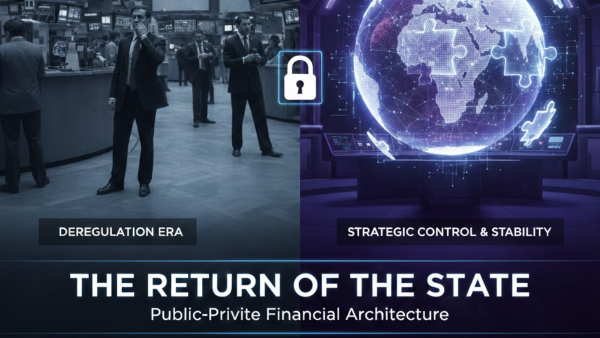
A core feature of the current era is the renewed role of the State. In the late 20th century, the private sector led through deregulation. Today, that balance has shifted. Governments are now deeply involved in shaping financial outcomes—directing credit allocation, supporting strategic industries (like semiconductors and green energy), and intervening to stabilize critical sectors.
Public financing tools, once viewed as temporary emergency measures, have become permanent features of modern “blended” economies. This does not signal the end of private finance; rather, it reflects a partnership where government policy and private capital operate to achieve national goals. Modern finance is now a combination of public policy, regulatory design, and institutional coordination.
3. Money as Infrastructure, Not Just Currency
The least visible but most important change is the transformation of “Monetary Infrastructure.” Traditionally, money was treated as a neutral medium of exchange. Today, the focus has shifted to the “Plumbing”: how money is issued, tracked, settled, and transferred.
The digital transformation is rewriting these processes. Transactions that once required multiple intermediaries now occur through streamlined digital frameworks, increasing speed and transparency while reducing “settlement risk.” This is not just a change in currency; it is a reform of the system’s foundation. Understanding payment processing, clearing mechanisms, and “financial plumbing” is now as critical as understanding a corporate balance sheet—a vital element in the financial world, as a company’s balance sheet fundamentally defines its financial position.
Conclusion of Part I
The modern financial system is no longer defined solely by the “Market.” It is a complex web of institutions, infrastructure, and long-term structural forces. Grasping these elements provides the foundation for true financial literacy in a rapidly changing world.
In Part II, we will examine how technology, human capital, and institutional trust are redefining the future of global finance.
Stoctok Discussion Questions for Part I
1. On Strategic Connectivity
“In an era of ‘Friend-shoring,’ if a country prioritizes security over cost, how do you think this will affect the inflation rates of everyday consumer goods?”
2. On the Return of the State
“We discussed how governments are now permanent partners in private finance. Can a financial system remain truly ‘free’ if the State is responsible for stabilizing its most critical sectors?”
3. On Monetary Plumbing
“If money becomes purely digital and programmable (like the systems discussed in my Bitcoin research), what happens to the role of traditional banks as intermediaries?”
4. On Future Readiness
“Which skill do you think will be more valuable for a 2026 finance graduate: the ability to analyze a stock’s price, or the ability to understand the technological infrastructure behind a global payment system?”